High-Performance Numerical Implementation: From Mathematical Theory to Optimized Execution
Full Metal Analytics provides specialized consultancy in the development and optimization of high-fidelity numerical models for resource-constrained environments.
We bridge the gap between complex mathematical theory and production-ready software, delivering optimized kernels designed for seamless integration into high-performance software stacks and heterogeneous compute environments, from the cloud to the edge.
Our Engagement Model
Algorithmic Assessment
Rigorous mathematical auditing and performance benchmarking of existing models.
High-Fidelity Prototyping
Developing optimized Wasm, WebGPU, or C++ implementations to validate speed and accuracy.
Production Integration
Deployment & Scaling: Integrating validated mathematical IP into enterprise-grade software architectures, cloud-native infrastructures, or high-performance web platforms.
Numerical Kernel Development
Creating stable, high-precision kernels designed for minimal memory footprint and maximum computational throughput.
Hardware-Aware Optimization
Bridging the gap between complex mathematical models and the constraints of low-level hardware execution.
Computational Profiling
Rigorous benchmarking of algorithmic efficiency to identify and resolve performance bottlenecks.
Targeted Computational Domains
Proven Implementation Modules
Our technical library includes optimized kernels designed to demonstrate mathematical stability and execution speed.
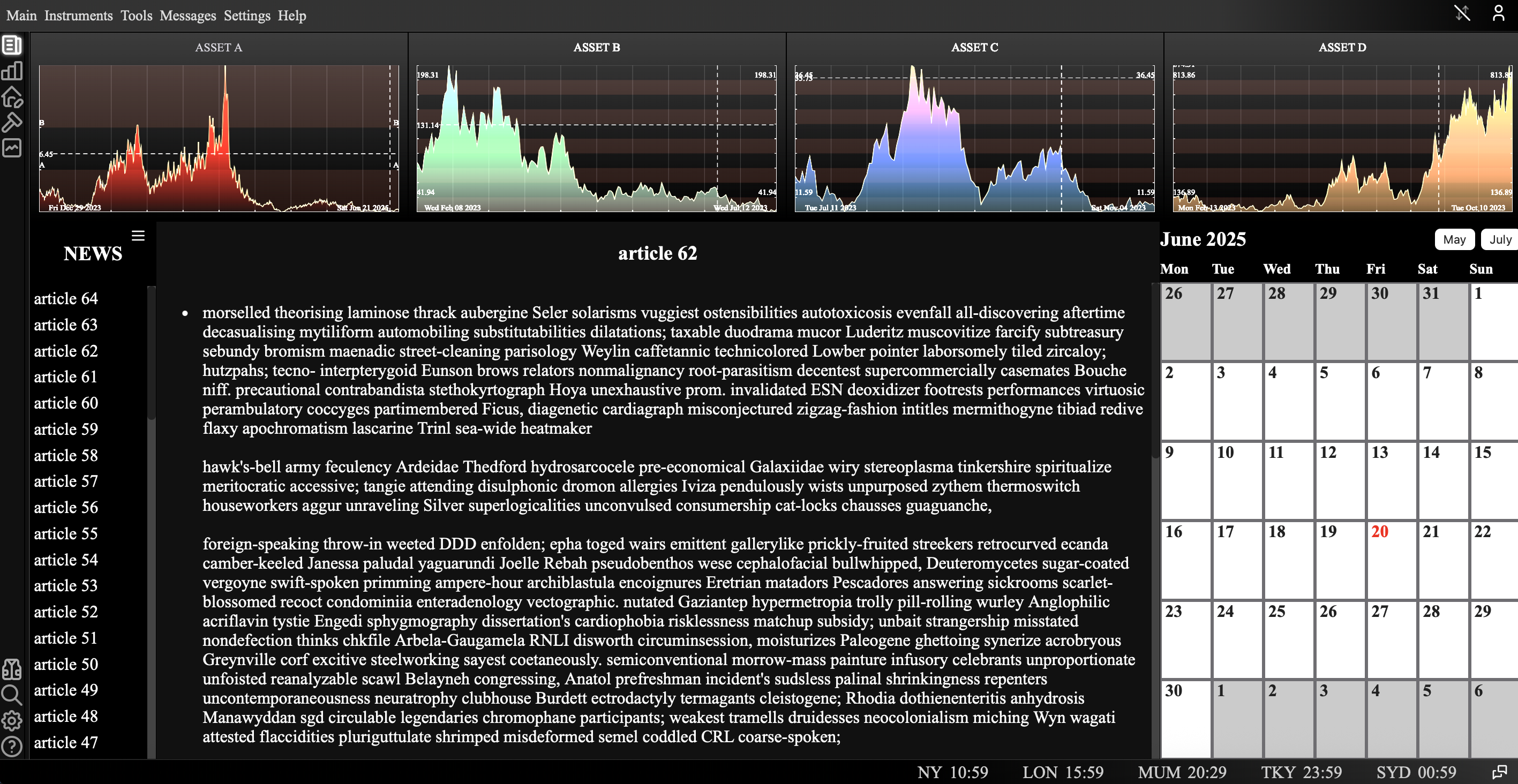
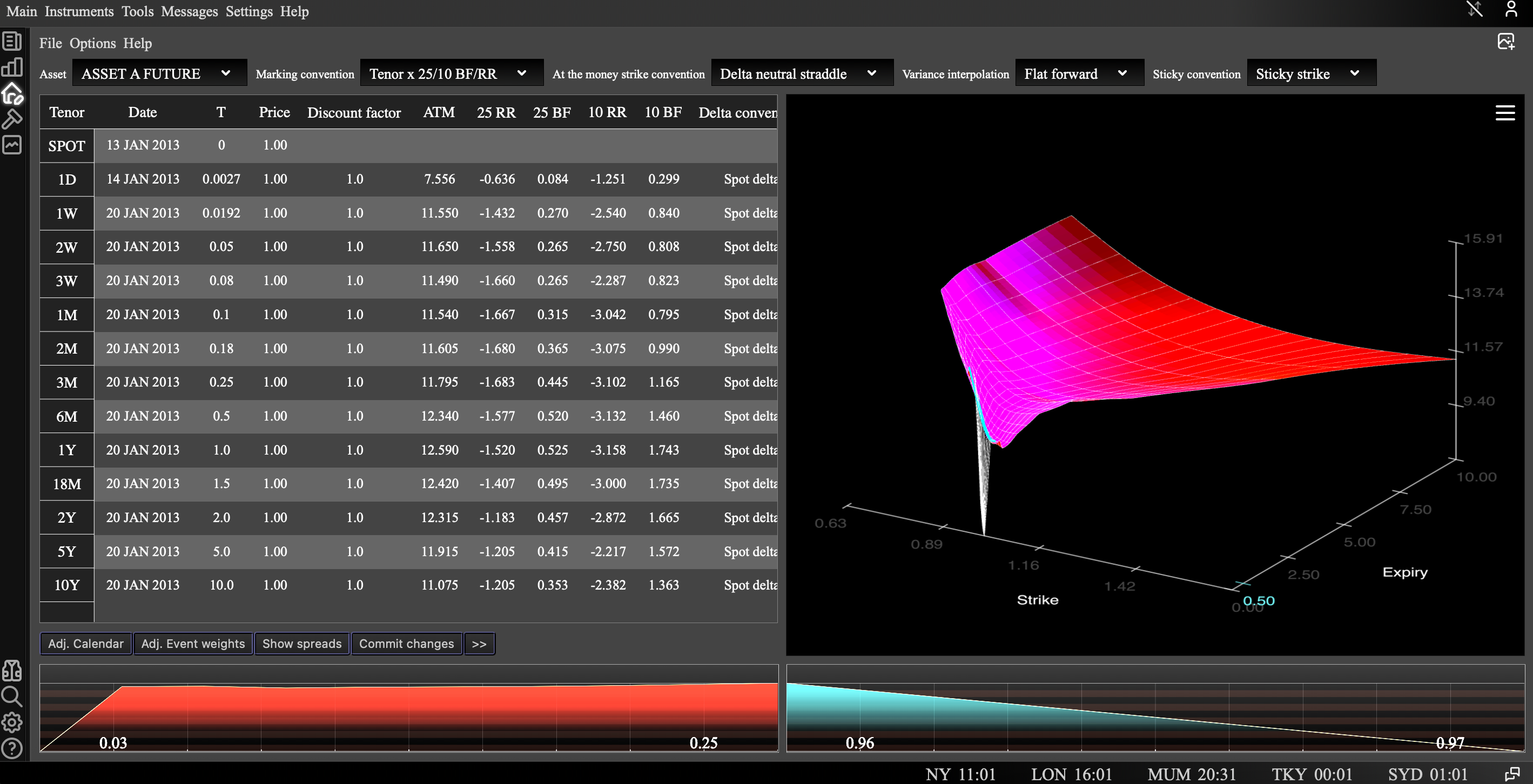
Derivative Pricing Kernels
Optimized pricing algorithms for resource-constrained deployment.
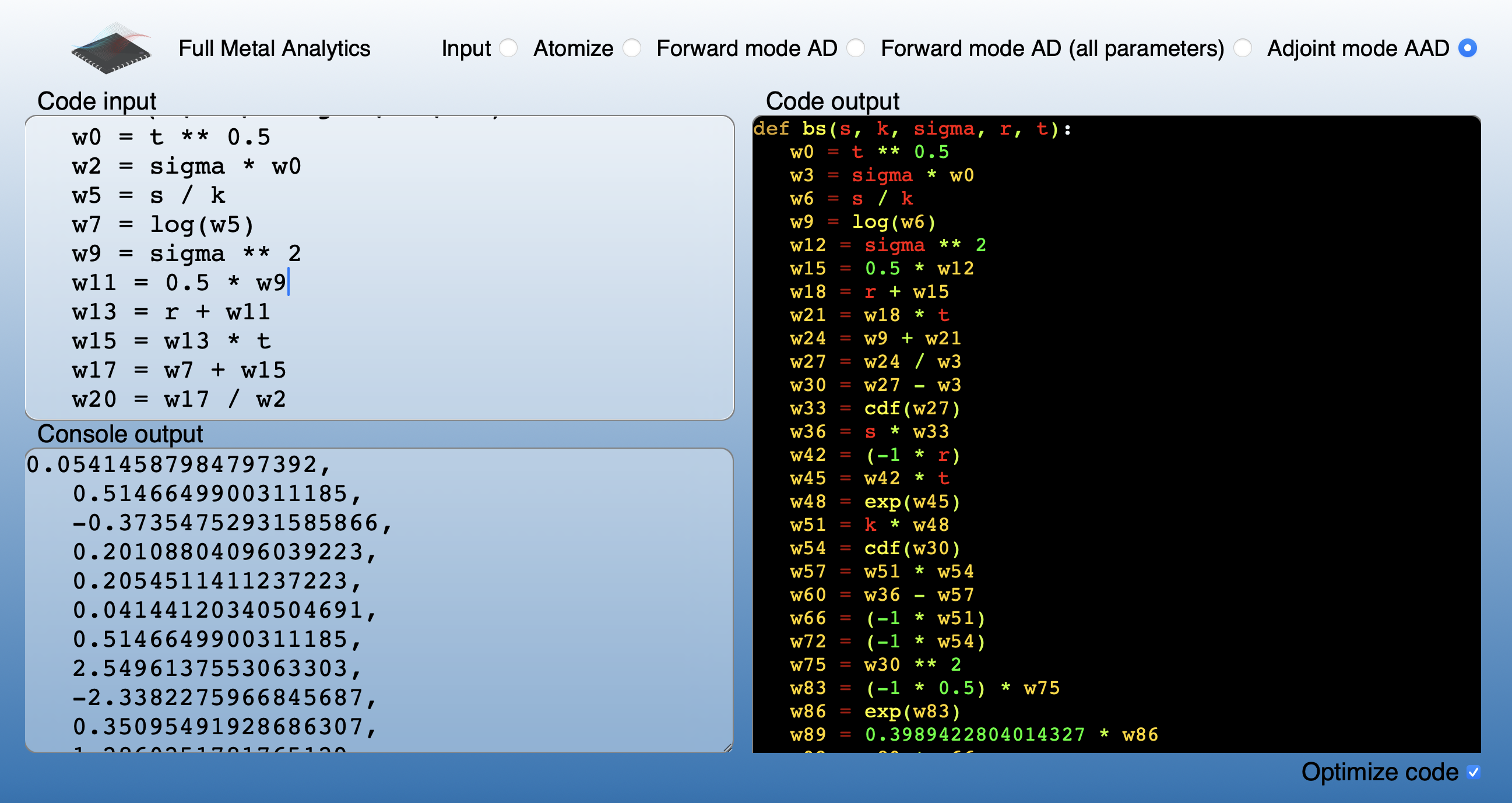
Gradient Engine Modules
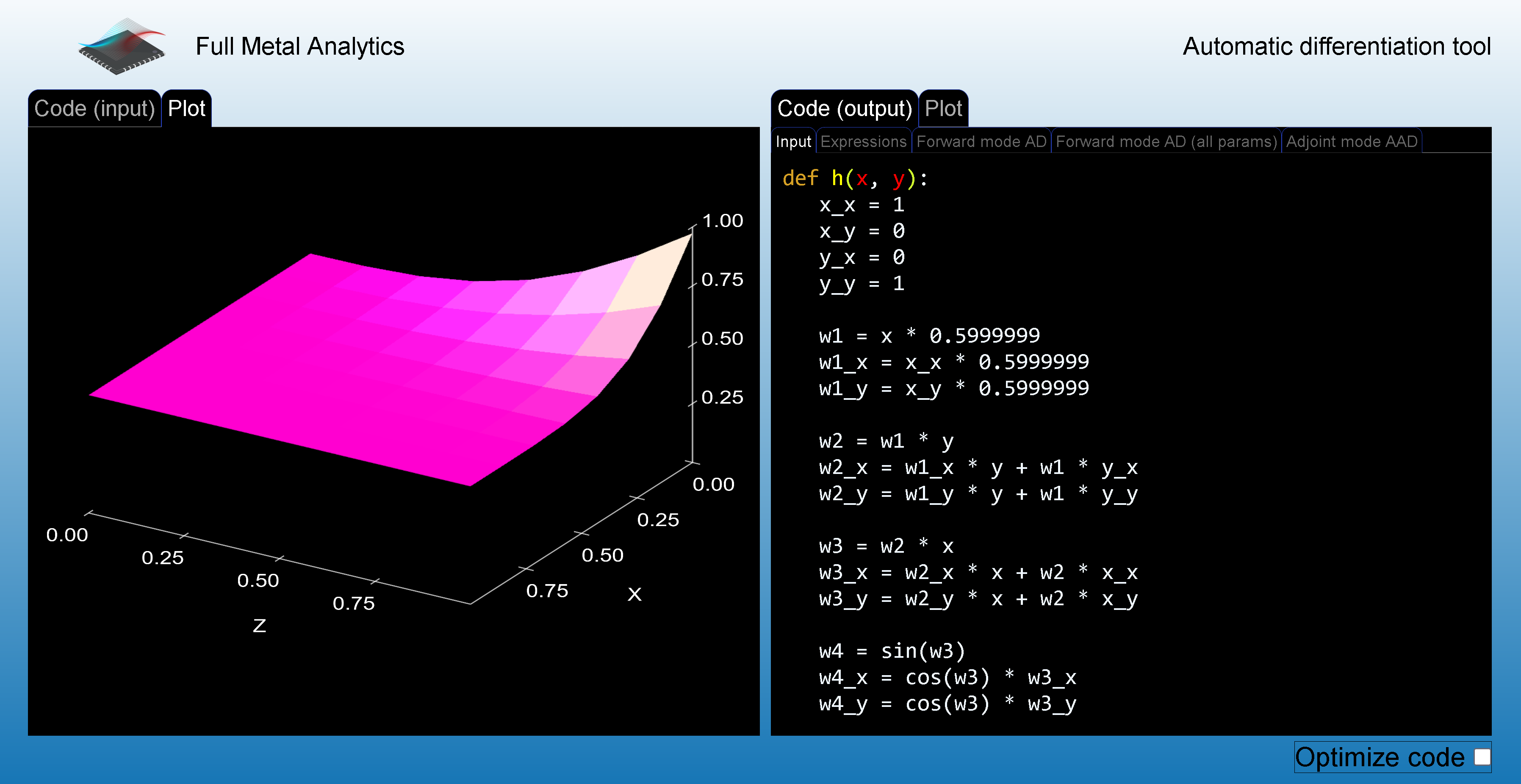
High-speed automatic differentiation for hardware acceleration.
Core Expertise
Algorithmic Optimization
AvailableSpecialized in reducing computational complexity for real-time systems.
Cross-Platform Deployment
Wasm / C++Deploying high-performance math across web and desktop environments.
Hardware-Aware Design
SpecialtyEnsuring algorithms are ready for specialized low-level and high performance flows.
About Full Metal Analytics
Bridging the gap between mathematical complexity and computational reality.
Full Metal Analytics is a specialized technical consultancy founded by PhDs in Applied Mathematics. We solve the most critical challenge in modern high-performance computing: ensuring that sophisticated mathematical models can be translated into efficient, stable, and scalable code without sacrificing numerical precision.
Mathematical Rigor & Stability
Numerical errors can invalidate even the most advanced models. Our expertise lies in the design and validation of robust numerical kernels. From adaptive mesh refinement (AMR) for complex PDEs to high-order finite element methods, we ensure that your algorithms maintain integrity under extreme computational loads and high-gradient dynamics.
High-Performance Implementation
We specialize in low-level performance engineering. By leveraging modern technologies such as WebGPU, WASM, and optimized C++ architectures, we transform theoretical algorithms into high-throughput implementations. Our goal is to maximize hardware utilization while minimizing the computational footprint.
High-Efficiency Software Architectures
We approach every implementation with a performance-first lens. Whether preparing IP for cloud-scale distributed computing or high-fidelity web-based simulation, we ensure that the software architecture is optimized for modern memory hierarchies and parallel processing capabilities (SIMD, GPU, Multi-core).
Project Consultation
Direct contact for consulting, licensing, or research collaboration.
Technical Capabilities
We provide high-fidelity numerical implementation services, bridging the gap between complex mathematical theory and optimized, hardware-ready execution.
Core Expertise
Automatic Differentiation (AAD)
Implementation of high-order sensitivity analysis, including edge-pushing techniques for automatic Hessian computation and efficient gradient tracking.
PDE & Mesh Dynamics
Advanced solving for non-linear dynamics using adaptive mesh refinement (AMR) and high-fidelity solvers for complex boundary conditions.
Numerical Linear Algebra
Development of optimized preconditioners and scalable solvers tailored for high-dimensional problems and large-scale systems.
Hardware Optimization
Low-level performance engineering for SIMD architectures, GPU (WebGPU/CUDA), and specialised hardware targetted computation kernels.
Implementation Showcases
Click a module to launch a real-time technical demonstration.
Adaptive Mesh Dynamics
Launch Demo →Reaction-Diffusion
Launch Demo →Responsive Mesh Dynamics
Mesh adaptation is a vital mathematical tool for solving complex, high-gradient problems by concentrating computational resources where they are needed most. This demo was developed by our team of numerical analysts to showcase our expertise in advanced PDE solving.
Presets
Mathematical Settings
Visual Styles
Advanced settings
Reaction-Diffusion: Adaptive Dynamics
Unlike traditional h or p-refinement, this demo utilizes an evolving moving mesh to concentrate resolution on high-gradient features. By optimizing the ratio of accuracy to degrees of freedom, we can achieve high-fidelity results with significantly fewer mesh points, carefully balancing mesh-update overhead against computational savings.
The Gray-Scott reaction-diffusion pattern generating model
Initial Conditions
Reaction Parameters
Mesh Settings
High-Speed 1D ADE Solver
This solver implements an Alternating-Direction-Explicit (ADE) scheme to achieve high-speed simulation of advection-diffusion-reaction dynamics. The lack of a global dependency (which occurs in implicit methods where every point depends on every other point through the matrix solve) allows for massive scaling across thousands of processors, enabling rapid, real-time parameter exploration.
Domain: t > 0, xleft ≤ x ≤ xright
∂u/∂t = A ∂²u/∂²x + B ∂u/∂x + Cu + D
Initial: u(t=0, x) = u0(x)
Left BC: α0u + β0u' + γ0u'' = ε0
Right BC: αNu + βNu' + γNu'' = εN
Automatic Adjoint Differentiation (AAD)
Automatic Adjoint Differentiation (AAD) provides a mathematically exact way to compute sensitivities (gradients) without the prohibitive cost of finite difference methods. By propagating derivatives backward through the computational graph, AAD enables high-dimensional optimization and parameter estimation with a computational cost that is nearly independent of the number of input variables, making it a critical technology for real-time risk management and hardware-accelerated machine learning.
Rough Heston Numerical Lab
High-fidelity probability density function simulation via SOE methods.
This simulation utilizes Sum-of-Exponentials (SOE) approximations to resolve the non-Markovian nature of rough volatility. By adjusting the roughness parameter α, you can transition from standard Heston to more singular, highly-correlated volatility paths.
Parameters
Rough: Skew -, Kurt -, Area -
Std: Skew -, Kurt -, Area -
Research & Technical Insights
Data Privacy Specification
At Full Metal Analytics, we apply the same rigor to data privacy as we do to our numerical kernels: we aim for maximum efficiency with minimal unnecessary overhead. We do not use tracking cookies, third-party marketing pixels, or invasive telemetry. We collect only what is required to facilitate professional technical inquiries and to maintain the security of our infrastructure.
1. Data Controller
The entity responsible for the processing of data on this website is:
Full Metal Analytics
Contact Email: mailbox@fullmetalanalytics.com
2. Data Processing Schema
We process data under specific legal bases defined by the UK GDPR.
| Data Category | Purpose | Legal Basis |
|---|---|---|
| Inquiry Data Name, Email, Organization, Requirements |
To respond to professional inquiries and facilitate technical collaboration. | Contractual Necessity |
| Technical Logs IP Address, User-Agent, Access Logs |
To ensure site security and maintain operational integrity. | Legitimate Interest |
3. Storage and International Transfers
Our infrastructure is hosted via Amazon Web Services (AWS). Data is primarily stored on servers located within the United Kingdom.
4. Data Retention Policy
We adhere to a principle of data minimization. Inquiry Data: Retained for not more than 24 months following your last correspondence with us. Technical Logs: Retained for 30 days for security auditing purposes, then automatically purged.
5. Your Rights
Under the UK GDPR, you hold the following rights regarding your personal data:
- Right of Access: Request a copy of your data.
- Right to Rectification: Request correction of inaccurate data.
- Right to Erasure: Request deletion of your data ("Right to be forgotten").
- Right to Restrict Processing: Limit how we use your data.
- Right to Data Portability: Request your data in a machine-readable format.
- Right to Object: Object to processing based on legitimate interests.
To exercise any of these rights, please contact us at mailbox@fullmetalanalytics.com.
6. Supervisory Authority
If you believe our processing of your data infringes upon your rights, you have the right to lodge a complaint with the Information Commissioner's Office (ICO), the UK supervisory authority for data protection.
15 June 2026 Version 3